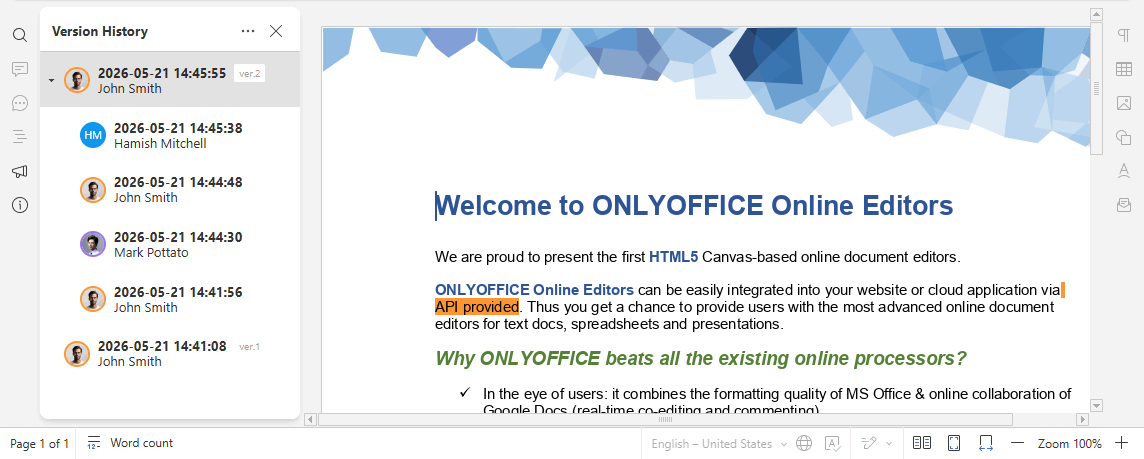
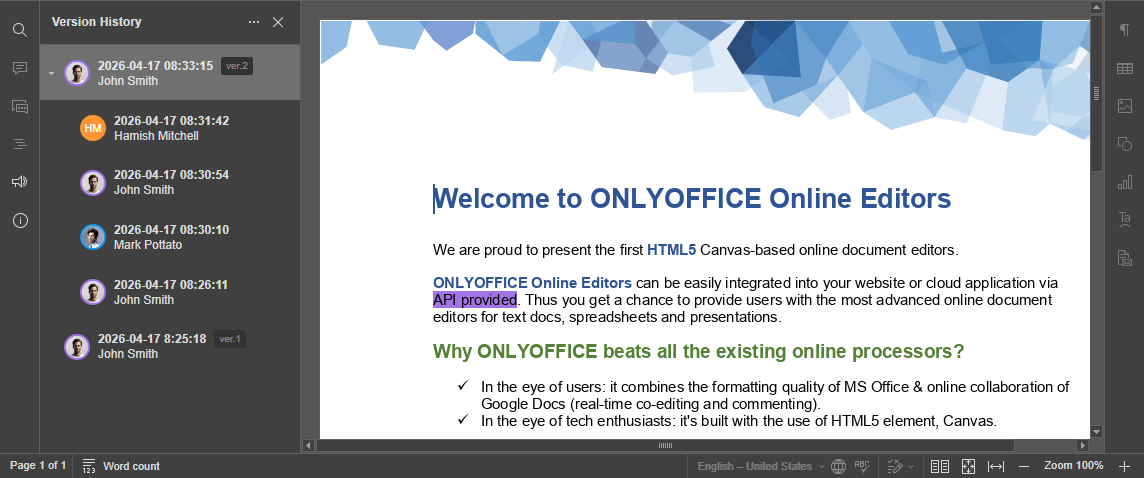
Document history
The document editor can display a version history for documents, spreadsheets, presentations, and PDFs. The version data itself is stored by the document storage service — after each editing session, ONLYOFFICE Docs returns change information that the integrator saves alongside the document. The document editor then shows this history as a version list in a side panel, where the user can select any version to preview it.
The figure and steps below explain how document history viewing works in ONLYOFFICE Docs.
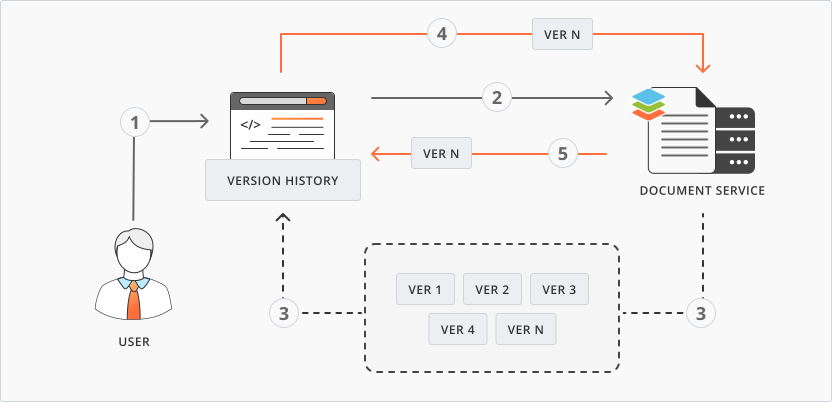
- The user clicks the Version History button in the document editor.
- The document editor requests the list of document versions from the document storage service.
- The document storage service returns the version list, including which version to display.
- The document editor requests the data for the selected version from the document storage service.
- The document storage service returns a link to the selected version's file.
- The document editor displays the selected version. If the user selects a different version, steps 4–6 repeat.
- The user clicks the Close History button, and the document editor returns to normal editing mode.
How this can be done in practice
-
Create an
.htmlfile to open the document. -
Add an onRequestHistory event handler to the editor config. When the user opens the version history, this event fires. In the handler, call refreshHistory with the full version list. To highlight individual changes within each version, pass additional data as described in highlighting changes.
function onRequestHistory() {docEditor.refreshHistory({currentVersion: 2,history: [{created: "2010-07-06 10:13 AM",key: "af86C7e71Ca8",user: {id: "F89d8069ba2b",name: "Kate Cage",},version: 1,},{created: "2010-07-07 3:46 PM",key: "Khirz6zTPdfd7",user: {id: "78e1e841",name: "John Smith",},version: 2,},],})};const config = {events: {onRequestHistory,},};const docEditor = new DocsAPI.DocEditor("placeholder", config);

-
Add an onRequestHistoryData event handler. When the user selects a version from the list, this event fires with the version number. In the handler, call setHistoryData with the absolute URL to that version's file.
When calling
setHistoryData, atokenmust be included to validate the parameters.function onRequestHistoryData(event) {const version = event.datadocEditor.setHistoryData({fileType: "docx",key: "Khirz6zTPdfd7",token: "eyJhbGciOiJIUzI1NiIsInR5cCI6IkpXVCJ9.eyJmaWxlVHlwZSI6ImRvY3giLCJrZXkiOiJLaGlyejZ6VFBkZmQ3IiwidXJsIjoiaHR0cHM6Ly9leGFtcGxlLmNvbS91cmwtdG8tZXhhbXBsZS1kb2N1bWVudC5kb2N4IiwidmVyc2lvbiI6Mn0.iRcdHve235L5K1e29SmUBkuHcxb63WHRko51WMJlmS0",url: "https://example.com/url-to-example-document.docx",version: 2,})};const config = {events: {onRequestHistoryData,},};const docEditor = new DocsAPI.DocEditor("placeholder", config);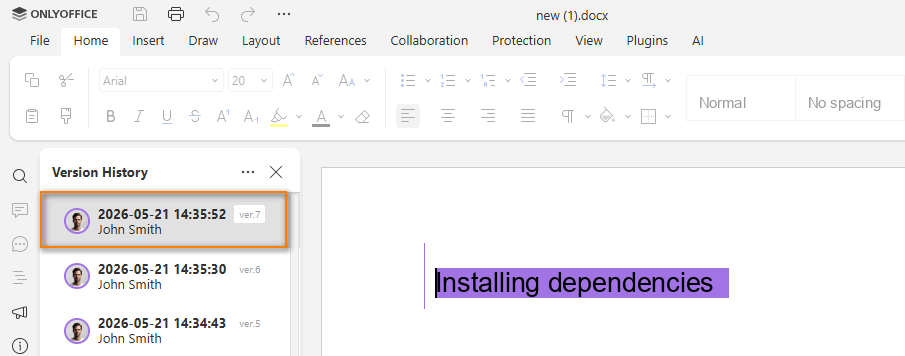
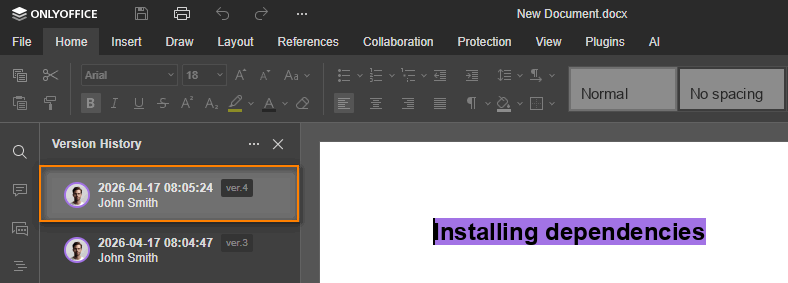
-
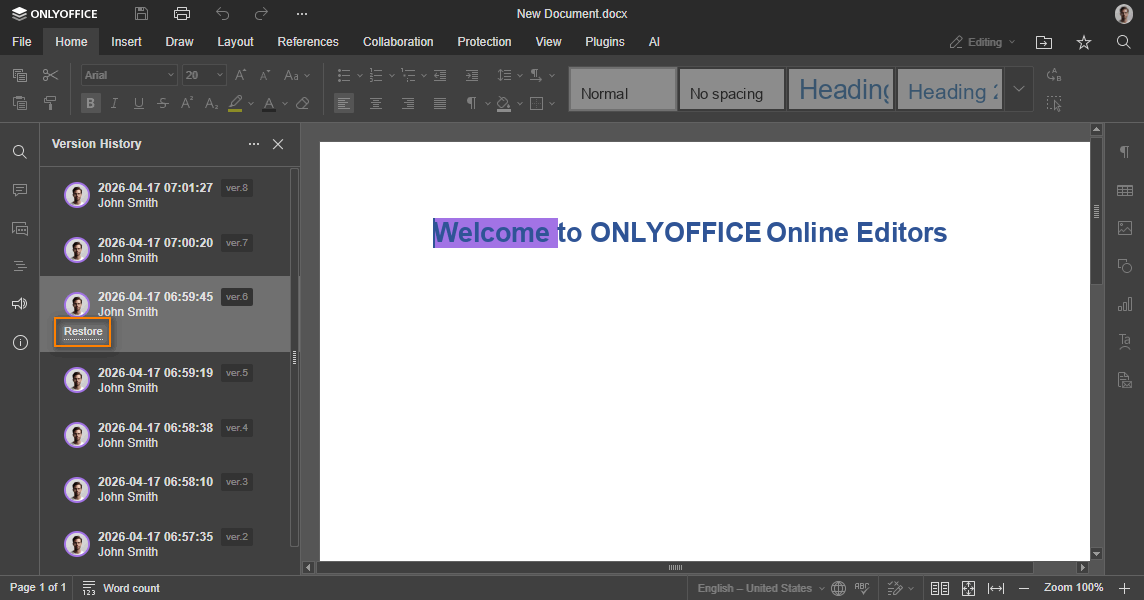
Add an onRequestRestore event handler. When the user clicks the Restore button, this event fires with the selected version's data. In the handler, save the restored version on your server and call refreshHistory to reload the version list.
function onRequestRestore(event) {const fileType = event.data.fileTypeconst url = event.data.urlconst version = event.data.versiondocEditor.refreshHistory({currentVersion: 2,history: [{created: "2010-07-06 10:13 AM",key: "af86C7e71Ca8",user: {id: "F89d8069ba2b",name: "Kate Cage",},version: 1,},{changes,created: "2010-07-07 3:46 PM",key: "Khirz6zTPdfd7",serverVersion,user: {id: "78e1e841",name: "John Smith",},version: 2,},],})};const config = {events: {onRequestRestore,},};const docEditor = new DocsAPI.DocEditor("placeholder", config);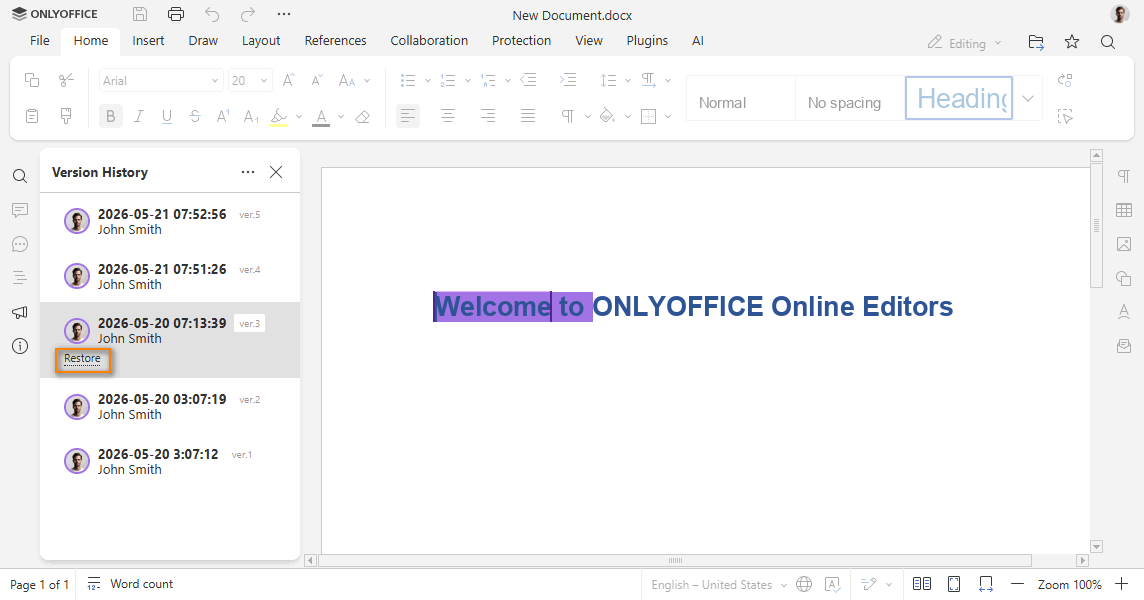
-
Add an onRequestHistoryClose event handler. When the user clicks the Close History button, this event fires. In the handler, reinitialize the editor in editing mode — for example, by reloading the page.
function onRequestHistoryClose() {document.location.reload()};const config = {events: {onRequestHistoryClose,},};const docEditor = new DocsAPI.DocEditor("placeholder", config);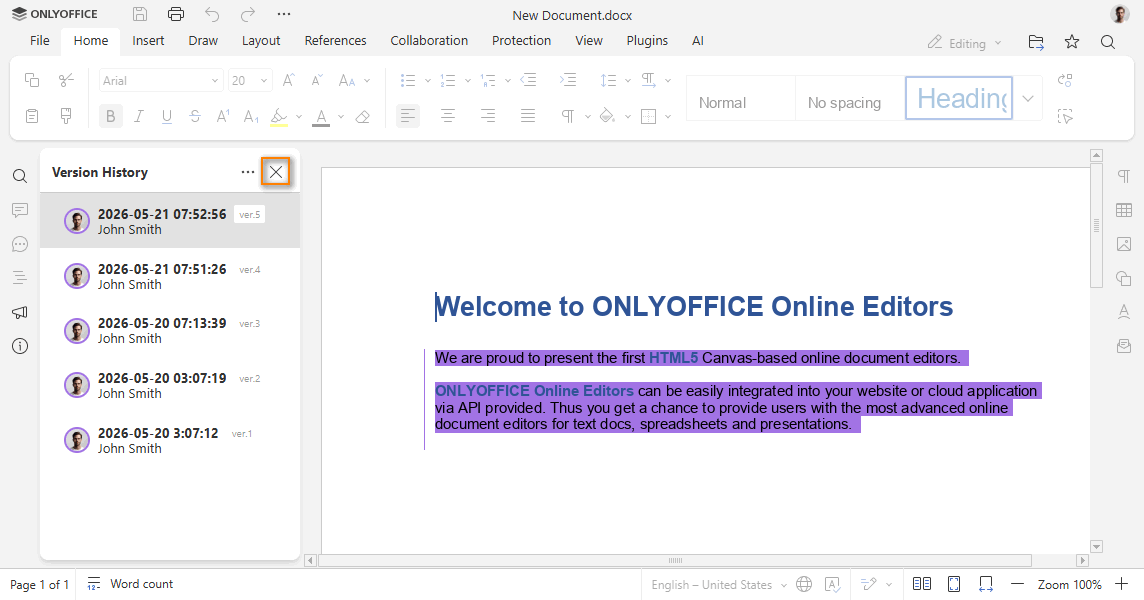
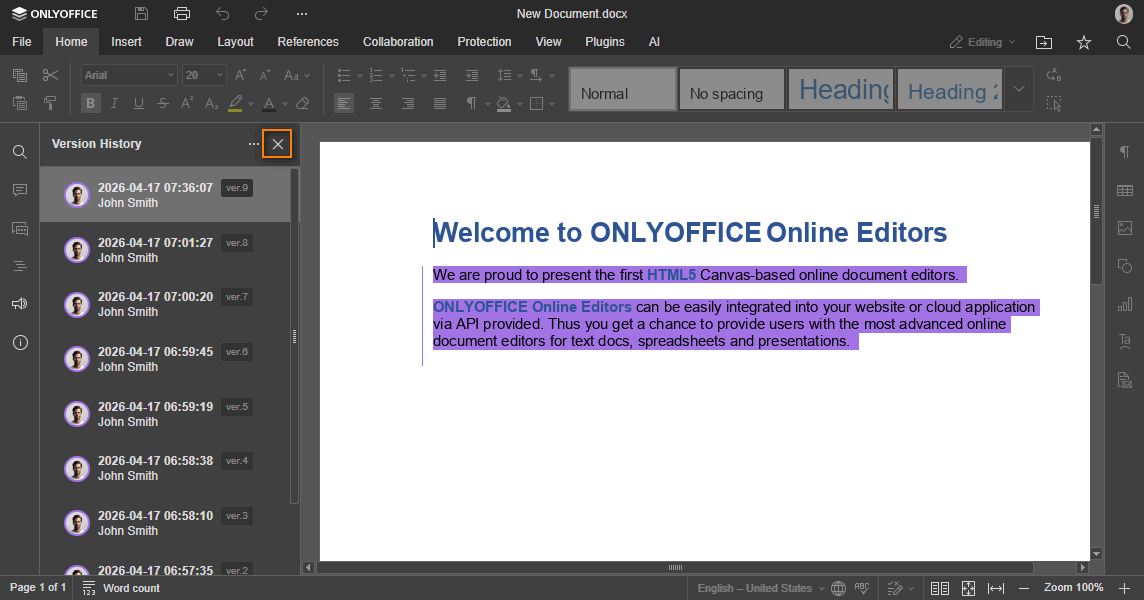
-
Open your
.htmlfile in the browser. -
Open the Version History option in the Document Editor menu.
Highlighting changes
If a document version was created with the document editor, the individual changes within that version can be highlighted when viewing the history. To enable this, the document storage service must save additional data returned by ONLYOFFICE Docs when saving each editing session.
When the server version is updated, the document editor does not use the changes data to highlight changes in the history. It only returns the changed document in the changesurl parameter.
Along with the changed document itself, the document editing service sends:
-
history — contains the timestamp and author for each change, displayed in the version history side panel. Pass this data as the
changesproperty of each version in the object passed to refreshHistory.docEditor.refreshHistory({currentVersion: 2,history: [{created: "2010-07-06 10:13 AM",key: "af86C7e71Ca8",user: {id: "F89d8069ba2b",name: "Kate Cage",},version: 1,},{changes,created: "2010-07-07 3:46 PM",key: "Khirz6zTPdfd7",serverVersion,user: {id: "78e1e841",name: "John Smith",},version: 2,},],})Where
changesandserverVersionare the values from the history object returned after saving the document.noteONLYOFFICE Docs highlights the changes made from the beginning of the current document session, not from the beginning of the document version. And even if several document versions are created during one session, all changes from this session will be highlighted. Therefore, you cannot see the document versions created with the force saving option in the document history.
-
changesurl — the absolute URL to a zip file with the editing data used to highlight changes for a specific version. Save this file and pass its address as the
changesUrlparameter when calling setHistoryData. You must also include a link to the previous document version inprevious.url.When calling
setHistoryData, atokenmust be included to validate the parameters.docEditor.setHistoryData({changesUrl: "https://example.com/url-to-changes.zip",fileType: "docx",key: "Khirz6zTPdfd7",previous: {fileType: "docx",key: "af86C7e71Ca8",url: "https://example.com/url-to-the-previous-version-of-the-document.docx",},token: "eyJhbGciOiJIUzI1NiIsInR5cCI6IkpXVCJ9.eyJjaGFuZ2VzVXJsIjoiaHR0cHM6Ly9leGFtcGxlLmNvbS91cmwtdG8tY2hhbmdlcy56aXAiLCJmaWxlVHlwZSI6ImRvY3giLCJrZXkiOiJLaGlyejZ6VFBkZmQ3IiwicHJldmlvdXMiOnsiZmlsZVR5cGUiOiJkb2N4Iiwia2V5IjoiYWY4NkM3ZTcxQ2E4IiwidXJsIjoiaHR0cHM6Ly9leGFtcGxlLmNvbS91cmwtdG8tdGhlLXByZXZpb3VzLXZlcnNpb24tb2YtdGhlLWRvY3VtZW50LmRvY3gifSwidXJsIjoiaHR0cHM6Ly9leGFtcGxlLmNvbS91cmwtdG8tZXhhbXBsZS1kb2N1bWVudC5kb2N4IiwidmVyc2lvbiI6Mn0.ril3Ol3rvYne3g0dG8TdKCiwJ7-7kkYGc6-XWMvp8FU",url: "https://example.com/url-to-example-document.docx",version: 2,})warningThe
changesurlrequest is made in the browser from the added iframe with thedocumentserverdomain, wheredocumentserveris the name of the server with ONLYOFFICE Docs installed. For correct operation, cross-origin HTTP requests must be allowed (CORS). This can be achieved using theAccess-Control-Allow-Originheader. You can register a free ONLYOFFICE Cloud and use its public IP address or public DNS that can be found in the Instances section of the cloud console.